
Loading Dalipco Machinery page content
/
Our 50L 100L High-Speed Vacuum Homogenizer delivers industrial-grade mixing performance for small to medium batch production in food and cosmetic industries.
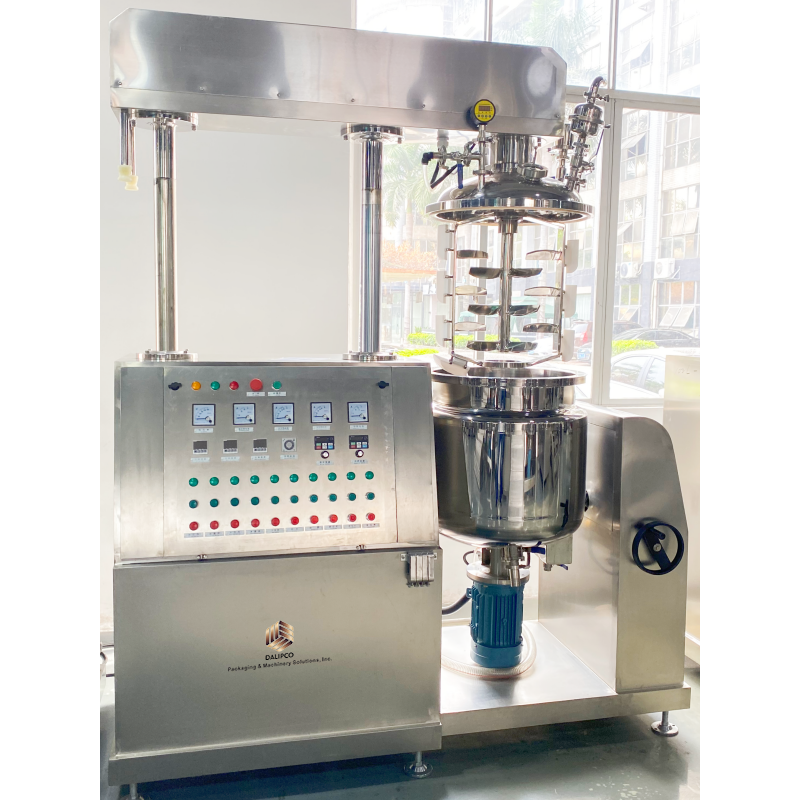
Our 50L 100L High-Speed Vacuum Homogenizer delivers industrial-grade mixing performance for small to medium batch production in food and cosmetic industries. Combining a vacuum range of -0.09 MPa with a 2960 RPM high- shear homogenizer, it creates products with consistent viscosity and texture—from smooth mayonnaise to creamy cosmetics.
Brief Introduction A vacuum emulsifying mixer is mainly composed of eight core system components. Each part complements each other in function and operates synergistically to provide a guarantee for the production of high- quality cosmetics: Water and Oil Dispenser Heating Tanks: Store water-phase and oil-phase raw materials respectively, ensuring classified storage and accurate proportioning of raw materials during the pre-treatment stage, which lays a foundation for subsequent emulsification; Main Emulsification Tank: As the core reaction vessel, it carries the processes of raw material mixing and emulsification, and provides a space for the realization of the functions of various systems; Vacuum System: Creates a vacuum environment during the emulsification process to remove air bubbles from materials, avoiding oxidation, foaming or uneven texture of cosmetics;
Inclined Discharge System: Facilitates the smooth discharge of materials after emulsification, reduces material residue in the tank, and improves production efficiency and material utilization;
Hydraulic Lifting System (Optional): Enables convenient lifting and lowering of the tank cover, facilitating equipment cleaning and internal maintenance, and optimizing operational convenience; Mixing System: Realizes preliminary stirring and dispersion of materials, enabling initial fusion of water-phase and oil- phase raw materials and preparing for homogenization;
Homogenizer System: Breaks down material particles through high-speed shear force, fully emulsifies water and oil phases, and forms a fine and uniform texture, ensuring the smoothness and stability of cosmetics;
Heating/Cooling System: Precisely controls the temperature during the emulsification process to meet the temperature requirements of different cosmetic formulas, and helps maintain the stability of active ingredients and improve emulsification effect.
The eight systems work together to control the entire process from raw material storage, mixing and emulsification to finished product discharge, ultimately producing cosmetics with fine texture, stability and high quality.
Product Specifications
Parameter Value Material 316L stainless steel (contact parts; 304 SS frame) Batch Size 50–100 liters Homogenizer Speed 0–2,960 RPM Mixing Speed 0-63 RPM Vacuum Degree -0.09 MPa Heating Method Electric (20–95°C) o Steam(up to 135°C) heating/Water Cooling Features
Dual-Scenario Quality Assurance: The mixing chamber sealed with food-grade silicone gaskets can not only prevent the oxidation of oils in food products such as mayonnaise and salad dressings, preserving flavor, color, and nutritional value; but also create a bubble-free environment for cosmetic production, ensuring that creams and foundations apply smoothly without streaking or pilling. It is suitable for production needs in both food and cosmetic fields.
Reduced Dependence on Additives: The vacuum environment can significantly reduce foaming during the mixing process. For sensitive formulations (such as low-irritation foods and mild cosmetics), there is no need to add additional defoaming agents to achieve a stable product state, balancing product safety and formula purity.
II. High-Speed Homogenization
Significant Improvement in Production Efficiency: Compared with traditional mixers, the emulsification time is directly reduced by 50%. Taking a 50L batch of mayonnaise as an example, conventional equipment takes 30 minutes, while this equipment can complete the process in only 10–15 minutes, significantly reducing production time and improving the turnover rate of small to medium batch production.
III. Easy Maintenance
Convenient and Efficient Cleaning: The homogenizer head and agitator support tool-free disassembly, requiring no complex tool operations. Thorough cleaning can be completed within 20 minutes, reducing the labor and time costs of equipment cleaning and shortening the waiting time between production batches.
Source-verified operational parameters and mechanical specifications for this equipment configuration.
| Parameter | Specification Value |
|---|---|
| Material | 316L stainless steel (contact parts; 304 SS frame) |
| Batch Size | 50–100 liters |
| Homogenizer Speed | 0–2,960 RPM |
| Mixing Speed | 0-63 RPM |
| Vacuum Degree | -0.09 MPa |
| Heating Method | Electric (20–95°C) o Steam(up to 135°C) heating/Water Cooling |
| Effective Capacity | 50L | 100L |
| Material | All product contact part are made of Stainless Steel 316L |
| Tank Design | Three layers, double jackets |
| Heating Methods | Eelctric heating(or steam heating) |
| Electric Heating Power | 9KW | 12KW |
| Mixing Design | Double way no-dead-angle mixing paddle with Teflon sraper |
| Mixing Power | 0.75KW | 2.2KW |
| Mixing Speed | 0-63rpm, customizable |
| Mixing Motor | ABB or SIEMENS |
| Homogenizer Design | High shear teeth-shape homogenizer |
| Homogenizer Position | Bottom/upper/inline homogenizer+rotary pump circulation type |
| Homogenizer Power | 4KW | 5.5KW |
| Homogenizer Speed | 0-2960rpm, customizable |
| Homogenizer Motor | ABB or SIEMENS |
| Vacuum Pressure | -0.1Mpa |
| Cover Type | Hydraulic lifting cover |
| Tank Titling | More than 90 degree tank body titling |
| Control Way | SIEMENS PLC control system and touch screen/push button |
| Customization | Weighing load cell/Electric lifting platform/Water flow meter/Water chiller/CIP system/Pump circulation |
Detailed inspection of verified station components, drives, and sanitation assemblies.
Effective Capacity 50L 100L Material All product contact part are made of Stainless Steel 316L Tank Design Three layers, double jackets Heating Methods Eelctric heating(or steam heating) Electric Heating Power 9KW 12KW Mixing Design Double way no-dead-angle mixing paddle with Teflon sraper Mixing Power 0.75KW 2.2KW Mixing Speed 0-63rpm, customizable Mixing Motor ABB or SIEMENS Homogenizer Design High shear teeth-shape homogenizer Homogenizer Position Bottom/upper/inline homogenizer+rotary pump circulation type Homogenizer Power 4KW 5.5KW Homogenizer Speed 0-2960rpm, customizable Homogenizer Motor ABB or SIEMENS Vacuum Pressure -0.1Mpa Cover Type Hydraulic lifting cover Tank Titling More than 90 degree tank body titling Control Way SIEMENS PLC control system and touch screen/push button Customization Weighing load cell/Electric lifting platform/Water flow meter/Water chiller/CIP system/Pump circulation
Explicit processing and packaging applications supported by this machinery model.
Food Industry: Processes mayonnaise, ketchup, salad dressings (Caesar, vinaigrette), aioli, and dairy spreads with stable emulsions.
Cosmetics: Blends foundation cosmetic creams, liquid lipsticks, hair gels, and facial serums requiring uniform pigment dispersion.
Pharmaceuticals: Formulates antibiotic ointments, topical creams, and medicated lotions with consistent active ingredient distribution.
Chemicals: Mixes adhesives, water-based paints, and inkjet inks with controlled viscosity and particle size.
Source-derived technical questions and operational clarifications for this machine.
The core function of the vacuum system is to remove air bubbles from materials, preventing product oxidation and deterioration, surface foaming, or uneven texture (such as stratification and gritty feeling), while also extending the product shelf life (for cosmetics and food products). Without the vacuum function, materials are prone to entraining air, which may cause cosmetics to pill during application, active ingredients in medical ointments to become ineffective due to oxidation, and food to develop off-odors or stratification, affecting product quality and user experience.
The capacity should be selected based on production scale and batch requirements: For small to medium-batch production (e.g., R&D laboratories, small factories), a 50L–100L capacity is suitable, which is adapted to sample development or scenarios with low daily output; for medium to large-batch production (e.g., industrial factories), a 200L–500L or larger capacity can be selected to meet the needs of continuous, high-yield production. At the same time, a certain margin should be reserved to avoid overloading the equipment, which may affect its service life.
Yes, they can process high-viscosity materials. The equipment uses the synergy of a high-power mixing system (e.g., variable-speed motor) and homogenizing shear force. Even for thick materials, it can break agglomerated particles to achieve uniform mixing; this vacuum emulsifying mixer also designed with an inclined discharge system, which can prevent high-viscosity materials from remaining in the tank, further ensuring mixing uniformity without mixing dead corners or unevenness.
Configure this unit to your formula volume, container type & speed requirements.
Connect with Dalipco machinery specialists to review changeover parts, line integration, throughput validation, or request formal quotation terms.